
The Pros & Cons of Becoming an HVAC Technician

| Update: April 22, 2026
HVAC is one of the more honest career conversations we have with prospective students at UEI College. There's real upside here, but it also comes with physical demands, on-call expectations, and a learning curve that not everyone anticipates. Here's a straightforward breakdown of both sides.
Interested In Our Heating, Ventilation and Air Conditioning Program? CLICK HERE >
The Pros of Becoming an HVAC Technician
HVAC systems need to be installed, maintained, and repaired by real people on-site. A large wave of experienced technicians is approaching retirement age, which means new entrants are stepping into a field with genuine openings. The work exists across residential service, commercial maintenance, new construction, and property management, so there are multiple sectors to build a career in.
You Can Get Started Faster Than You Might Think
A major draw for many students is the timeline. HVAC training programs can be completed in as few as 10 months. Compare that to a two- or four-year degree, and you're looking at a significantly shorter path to entering the field.
At UEI College, our Heating, Ventilation and Air Conditioning (HVAC) program covers both the theory and hands-on skills needed to pursue work in the trade, including refrigeration cycles, electrical components, ductwork, diagnostics, and EPA certification prep. The hybrid format combines online lectures with in-person lab time using real equipment.
Hands-On Work with Tangible Results
HVAC technicians troubleshoot real systems, solve actual problems, and walk away from each job with a clear result. For people who find desk work unfulfilling, that daily feedback loop is genuinely satisfying.
There's also a meaningful dimension to the work. Restoring heat for a family in winter or getting an A/C running again during a heat wave isn't abstract. People notice, and the job carries a sense of purpose that a lot of careers can't offer.
The Career Has Real Room to Grow
Entry-level HVAC work is only the beginning. From there, technicians can specialize in commercial systems, refrigeration, or Building Automation Systems, which is the digital controls side of the industry that's expanding as buildings get smarter. Others move into supervision, estimating, or eventually start their own businesses.
The trade is also evolving. Heat pump technology is expanding rapidly, and technicians who understand high-efficiency systems and IoT-connected HVAC are finding their skills particularly useful.
EPA Certification Opens More Doors
Federal law requires anyone who handles refrigerants to hold EPA Section 608 certification. It's a non-negotiable credential in the trade. UEI's program prepares students to sit for this certification, which covers all refrigerant types under the Universal certification and is recognized nationally.
Having this credential from the start puts graduates in a stronger position than applicants who haven't gone through formal training.
Interested In Our Heating, Ventilation and Air Conditioning Program? CLICK HERE >
The Cons of Becoming an HVAC Technician
The Physical Demands Are Real
HVAC work involves attics, crawlspaces, rooftops, and tight mechanical rooms, often in extreme heat or cold. Summer attic work in particular puts real strain on the body. Add in repetitive crouching, kneeling, and lifting heavy equipment over a multi-decade career, and physical wear becomes a genuine consideration.
This doesn't disqualify the career, but taking care of your body matters. Technicians who use mechanical assists, practice proper lifting technique, and stay physically fit tend to have longer, more sustainable careers.
On-Call Rotation Is Part of the Job
During peak seasons, when it's unusually hot or cold, HVAC technicians are often expected to be available outside regular hours. Emergency calls happen, and many employers rotate on-call duty among their teams. For some people, this unpredictability fits their lifestyle fine. For others, it's a consistent source of frustration.
It's worth asking about on-call policies when evaluating potential employers. Some companies have more structured rotation systems than others, and that difference can significantly affect work-life balance.
There's a Real Safety Component
HVAC technicians work with high-voltage electrical circuits, pressurized refrigerants, and combustible gases. The risks require ongoing awareness and proper training. The newer generation of A2L refrigerants, which are mildly flammable, adds another layer of protocol that technicians need to stay current on.
This is one reason why formal training matters. Understanding the safety requirements before stepping into the field reduces the likelihood of serious incidents. Our HVAC safety curriculum covers these protocols as a core part of the program.
Seasonal Fluctuations Can Affect Workload
HVAC work tends to spike during summer and winter and slow down in spring and fall. New technicians sometimes find the shoulder seasons lighter on hours. Experienced techs who've built a client base or moved into commercial maintenance work tend to have more consistent year-round schedules, but it's something to plan for early in your career.
Licensing Requirements Vary by State
There's no single national HVAC license that works everywhere. Each state has its own requirements for how long you need to work in the trade before applying for a contractor or journeyman license, and reciprocity between states isn't consistent. Licensing requirements vary considerably. California's C-20 HVAC contractor license, for example, requires four years of experience, while other states have different structures entirely.
If you anticipate moving between states, it's worth researching what that transition looks like for licensing before you get deep into your career in one location.
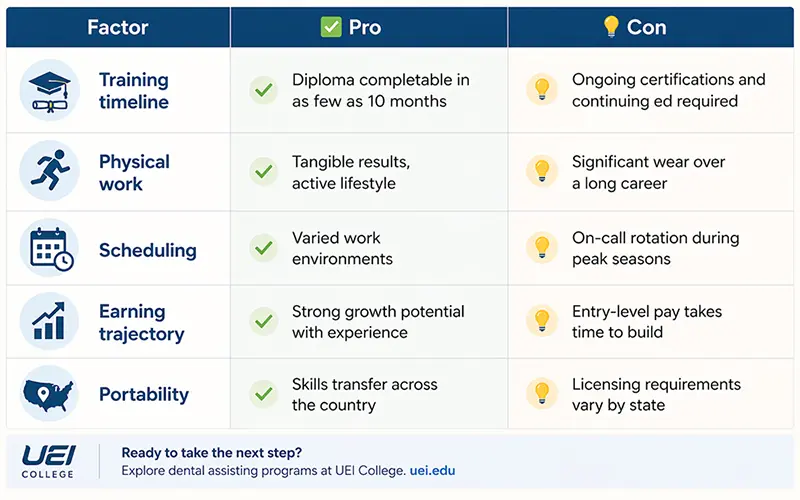
Pros vs. Cons at a Glance
Is Becoming an HVAC Technician Worth It?
For the right person, yes. HVAC offers a career path with skilled, certified technicians can pursue work across a wide range of employers and environments, with real room to advance over time.
The trade does ask something of you physically, and the on-call reality is worth understanding before you start. But for people who prefer hands-on work over a desk, those trade-offs tend to be manageable.
If you want to understand more about what the day-to-day actually looks like, our guides on where HVAC technicians work and what you learn in an HVAC program go deeper on both.