
Do You Need a Degree to Become a Medical Biller and Coder? (2026)

| Update: November 10, 2026
No, you do not need a four-year college degree to become a medical biller or coder. The typical entry route is a postsecondary career training program, not a traditional associate or bachelor's degree. At UEI College, our Medical Billing and Insurance Coding (MBIC) program provides foundational training in medical billing, insurance coding, and medical office procedures. The program is designed to prepare students for entry-level opportunities in medical billing and related healthcare administrative roles. Certain medical coding positions may require additional training, certification, or professional experience.
That said, "no degree required" does not mean "no education required." While some positions accept a high school diploma paired with relevant healthcare experience, formal postsecondary training is the more common pathway. A focused diploma program covers the coding systems, billing processes, software skills, and compliance knowledge that employers expect from a new hire.
What Education Do You Need for Medical Billing and Coding?
There's more than one way into this field. The right path depends on your goals, your timeline, and whether you already have healthcare experience.
A high school diploma or equivalent is the educational foundation. It's the minimum requirement for most entry-level positions and for enrollment in formal training programs, including UEI's. On its own, though, a high school diploma may limit your options if you don't already have experience in a healthcare setting. Check out our enrollment requirements for full details on what you need to apply.
A career diploma program is the most direct route for someone starting fresh. These programs focus specifically on the skills needed for entry-level billing and coding work: coding classification systems, medical terminology, insurance claims, billing software, and privacy compliance. Because they skip the general education courses required by degree programs, they can be completed faster. UEI's program, for example, can be completed in as few as 10 months.
An associate degree is a valid option if you want broader health information education, but it typically takes at least two years. It includes general education coursework alongside the career-specific training, which extends the timeline.
A bachelor's degree is not required for entry-level medical billing and coding work. It generally takes four to five years and covers far more ground than a billing and coding role requires. That said, a bachelor's degree may become useful later if you want to move into health information management, data analytics, or leadership roles.
Here's how the pathways compare:
| Education Path | Typical Timeline | What It Covers | Who It's For |
| High school diploma/GED only | No additional training | General education | Someone with existing healthcare work experience |
| Career diploma program | Under one year (UEI: as few as 10 months) | General education | Someone with existing healthcare work experience |
| Associate degree | Two or more years | Career training plus general education courses | Someone who wants a broader academic foundation |
| Bachelor's degree | Four to five years | Extensive coursework across health information, management, and general studies | Someone planning for management or health information leadership roles |
What Does a Medical Billing and Coding Program Teach You?
Formal training matters because medical billing and coding requires specific technical knowledge that you can't realistically pick up without a foundation. You need to understand coding systems, insurance rules, medical documentation, and privacy law before you can contribute in a professional setting. For a more detailed look at the curriculum, we have a full walkthrough.
Here are the core areas a training program should cover.
Coding Classification Systems
Medical coders translate documented diagnoses, treatments, and procedures into standardized codes used for insurance claims and healthcare records. The three major code sets you'll learn are:
- ICD-10-CM for diagnosis coding, maintained by the CDC's National Center for Health Statistics
- CPT (Current Procedural Terminology) for procedures and professional services
- HCPCS Level II for additional healthcare procedures, supplies, and equipment
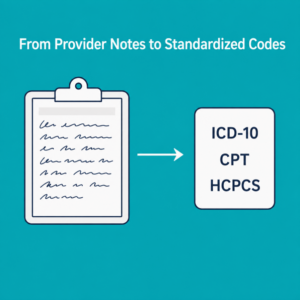
UEI's curriculum teaches all three coding systems through hands-on practice with coding manuals and billing software.
Medical Terminology and Anatomy
Coding is more than looking up numbers. You need to read and interpret provider documentation well enough to connect a diagnosis or procedure with the correct code. That means understanding medical terminology, anatomy, disease processes, and how documentation is structured. UEI's program covers anatomy, prefixes and suffixes, abbreviations, and body-system-specific terminology across multiple modules.
Insurance, Claims, and Reimbursement
The billing side of the field involves processing insurance claims, verifying coverage, following up on unpaid or denied claims, and managing patient billing. You'll learn to work with different payer types, including private insurance, Medicare, Medicaid, workers' compensation, and managed care plans. UEI students practice hands-on with the CMS-1500 claim form, one of the most commonly used forms in medical billing.
EHR and Billing Software
Electronic health record systems and billing software are central to everyday work in this field. Patient information, coding entries, claims submissions, and payment tracking all run through digital systems. Familiarity with EHR systems and billing software is one of the areas where employers expect new billing and coding professionals to be prepared. UEI's program includes hands-on work with billing software and electronic health records standards.
HIPAA, Privacy, and Compliance
Patient confidentiality is a core professional obligation. Medical billers and coders handle sensitive health information daily, and errors carry real consequences. Training programs cover HIPAA regulations, medical law, ethics, and the administrative and legal requirements that govern how medical records are handled. UEI's curriculum includes dedicated HIPAA training and a full module on medical law and ethics.
What's the Difference Between Medical Billing and Medical Coding?
The terms are often grouped together, but they describe two related functions.
Medical coding is the process of translating diagnoses, treatments, and procedures from medical documentation into standardized codes. Coders review provider notes and assign the appropriate ICD-10, CPT, and HCPCS codes for each patient encounter.
Medical billing takes those coded records and uses them to submit insurance claims, manage reimbursements, and handle patient invoicing. Billers make sure each claim is submitted correctly, follow up when claims are denied, and set up payment plans when needed.
In smaller offices, one person often handles both functions. In larger facilities, billing and coding may be separate roles. Either way, training programs typically cover both sides, which is why the field is referred to as "medical billing and coding" rather than just one or the other. You can learn more about the career paths available after completing a billing and coding program.
Do You Need a Professional Certification?
Professional certification is separate from earning a diploma or degree. A diploma represents the education you've completed. A certification is a credential earned through an independent organization, usually by passing an exam.
Certifications are not state licenses, and medical billing and coding is generally not a state-licensed occupation. However, many employers prefer certified candidates, and some require certification at the time of hire or shortly after. If you're curious about the distinction, our article on whether you need a license covers it in more detail.
Here are the major certifications relevant to this field:
| Certification | Organization | Focus | Entry-Level Fit |
| CPC (Certified Professional Coder) | AAPC | Professional services coding using CPT, ICD-10-CM, and HCPCS Level II | Widely recognized coding credential; new coders without qualifying experience may initially carry apprentice status |
| CCA (Certified Coding Associate) | AHIMA | Interpreting healthcare data and evaluating medical claims | Designed for early-career professionals; strong fit for new graduates |
| BCBS (Certified Billing & Coding Specialist) | NHA | Both medical billing and coding competencies | Covers both billing and coding, making it relevant to the full scope of the occupation |
| CCS (Certified Coding Specialist) | AHIMA | Advanced classification of medical record data | Generally pursued by professionals with coding experience; a natural next step after CCA |
You don't need a four-year degree to pursue any of these credentials. But it's worth checking the qualifications expected by the employers you plan to apply to, since requirements vary.
Can You Work Remotely in Medical Billing and Coding?
Remote work is common in medical billing and coding, particularly among experienced professionals. That said, fully remote positions typically come with experience requirements. Many employers ask for at least one to two years of coding experience before offering remote work, and some require more.
If you're just starting out, your first position may be onsite or hybrid while you build hands-on experience. As you develop a track record with specific code sets and payer types, remote opportunities become more realistic.
The work itself is well suited to a computer-based environment. Medical coders and billers work with digital records, coding databases, and billing software, so the job can technically be done from anywhere with a secure internet connection. Remote work is a realistic long-term benefit in this field, but it may not be a feature of your first position.
What Jobs Can You Pursue After Training?
Graduates of the Medical Billing and Insurance Coding program may pursue entry-level employment opportunities in medical billing, insurance claims processing, medical records support, and related healthcare administrative positions. Some positions, particularly those involving specialized medical coding, may require additional education, professional certification, or experience depending on employer requirements. Common roles include:
- Medical Coder
- Medical Biller
- Medical Billing and Coding Specialist
- Health Information Clerk
- Health Information Specialist
- Health Information Technician
- Medical Records Clerk
- Medical Records Coordinator
- Medical Records Technician
These roles exist across a variety of work environments, from medical offices and clinics to hospitals, insurance companies, and billing service providers. The specific title and setting will depend on the employer, but the core skills are consistent across all of them.
Job titles and employer requirements vary. Some positions may prioritize certification, while others may weigh practical experience or a specific software background. Reviewing job postings in your area will give you the clearest picture of what local employers are looking for.
How to Start Your Medical Billing and Coding Career
If a focused career training program sounds like the right fit, here's what the path looks like at UEI College.
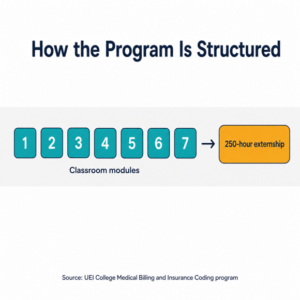
Our Medical Billing and Insurance Coding program is a diploma program that can be completed in as few as 10 months. The program uses a hybrid format: you'll join live online lectures from any device and attend hands-on workshops on campus approximately twice per week, with morning and evening sessions available. We have campuses across multiple states, and new classes start monthly.
The MBIC curriculum introduces students to foundational knowledge and practical skills in medical billing, insurance coding, medical terminology, anatomy, insurance claims processing, electronic health records, HIPAA compliance, and medical office procedures. Students gain exposure to ICD-10-CM, CPT, and HCPCS Level II coding systems while developing an understanding of healthcare billing workflows.
To enroll, you'll need a high school diploma or GED equivalent. No prior healthcare experience is required. Financial aid is available for those who qualify.
When you graduate, our Career Services team provides job placement assistance, including resume support, interview preparation, and employer connections.
Ready to learn more about pursuing a career in medical billing and coding? Contact us to schedule a campus visit, or request more information about the program online.