Course Title
This course is an industry-designed course covering safety topics specific to the construction industry. This provides the electrical worker with instruction in general construction site safety, measurements, and formulas, use of hand and power tools, interpretation of blueprints, basic rigging techniques and methods used to move equipment and materials. In this course the student will be taught basic math for calculation and accurate measurements.
Additionally, this course provides students with training in OSHA 10 regulations and CPR for safety and health in the construction industry, as well as safe working practices for electricians servicing electrically live installations mandated by NFPA 70. There are no prerequisites.
Introduction to Electrical Theory
+
This course will provide instruction on the various laws and principles of electricity. An examination of electrical energy fundamentals, the relationships of electrical quantities within Ohm?s Law and the principles of magnetic induction, transformers and capacitors serve to provide an overview of electrical power generation. Also, this course will provide instruction on the various types of electric motors and their applications. Topics consist of single-phase and three phase motors, capacitor start/run motors and interrupting the nameplate data to provide the student with a working knowledge of electrical motors. There are no prerequisites.
Flexible Cables/Conduit Bending and Raceways
+
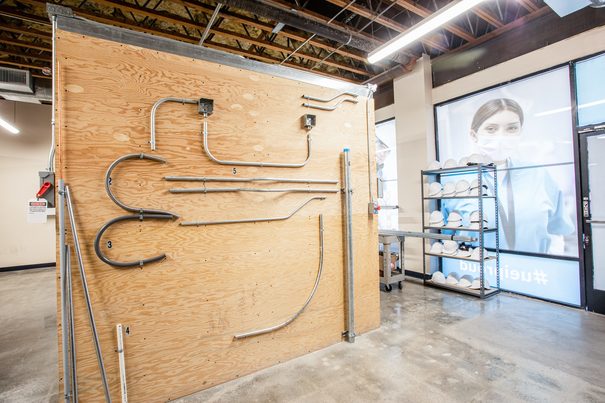
This course will provide instruction on various flexible conduits and flexible cable assemblies. Students will learn the NEC code requirements for listed flexible conduits and cables along with the installation requirements and their associated connectors and fittings. This course will provide hands-on applications in the installation of conduits in both metallic with other raceways commonly used in commercial electrical wiring. Students will perform the mechanics of bending to form different types of bends. There are no prerequisites.
Residential Applications
+
This course will provide instruction on various flexible conduits. It will prepare the student for the challenges of designing and drawing a National Electrical Code (NEC) governing branch circuit requirements for residential structures. Students receive instruction on load calculations, receptacle placement, lighting outlets, Ground Fault & Arc Fault protection, electrical symbols, and prints, along with the requirements for grounding, bonding, conductor identification, and sizing calculations for service equipment. Prerequisite: EL110, EL120, and EL130
Commercial Applications
+
This course gives the student an introduction to commercial wiring methods and three phase electrical distribution systems. The course will help the student read and understand blueprints used in commercial applications. It shall cover the proper use and identification of materials associated with commercial electrical work. It teaches the student specific code requirements related to commercial applications as well as the ability to calculate service, feeder, and branch circuit requirements. It also establishes the principles of proper maintenance and troubleshooting. Prerequisite: EL110, EL120, and EL130
Low Voltage Applications
+
This course provides an overview of the alarm, telecommunications, and entertainment electronics industries from a technician?s perspective. It covers the makeup, identification, and applications of various types of conductors and cables used in telecommunications and security systems. It also provides information and detail instruction for selecting, installing, testing, and terminating devices on various cables used in low voltage work. Prerequisite: EL110, EL120, and EL130
Motor and Industrial Motor Controls
+
This course will provide instruction on the various types of electric motors and their applications. Topics consist of single-phase and three-phase motors, capacitor start/run motors, direct current motors and interrupting the nameplate data to provide the student with a working knowledge of electrical motors. It will provide the students with a working knowledge of industrial motor controls.
Starting with some of the most basic electronic devices, students will move from simple control circuits to an array of complex and intricate circuits. Topics include timers. Start and stop switches, pressure, temperature, and other sensors along with many others that challenge today?s electricians and instrumentation technicians. Prerequisite: EL110, EL120, and EL130
Programmable Logic Controls
+
This course introduces the students to the principles of solid-state control and examines various applications that are relevant to the electrician. It introduces the students to electricity and semiconductor fundamentals. Students will identify, test, and work with components that explain basic digital logic elements, flip-flops, shift registers and counter, the function and purpose of programmable logic controllers (PLC), different numbering systems used in PLCs, and the hardware and software use in PLCs. Prerequisite: EL110, EL120, and EL130
Solar Electric Applications
+
This course provides an overview of photovoltaic (PV) science and an introduction to the fundamentals of solar energy. Through a combination of lecture and hands on lab exercises, students will learn the concepts and processes of photovoltaic systems, including their design and installation. The module covers the scope of solar energy system?s conceptual, mechanical, and electrical design, with an emphasis on wiring and electrical issues. Prerequisite: EL110, EL120, and EL130