
What Tools and Techniques Are Taught in HVAC Training?

| Update: December 15, 2025
If you’re considering becoming an HVAC technician, you’re likely wondering what tools and techniques are taught in HVAC training. This guide will provide you with everything you need to know about what these programs cover.
What Do HVAC Technicians Do?
HVAC technicians provide a valuable service to businesses and residents. Whether you live in a hot or cold climate, almost every home or business requires some type of heating or cooling system to maintain a comfortable temperature. HVAC technicians install and connect these systems to plumbing or electricity. They also repair and maintain refrigeration equipment that helps preserve necessities like food and medications.
To learn all these skills, it’s important for a prospective HVAC technician to receive comprehensive training through an HVAC training program.
What Does the HVAC Program At UEI College Teach?
The HVAC Training Program at UEI College teaches basic electricity, motors, and HVAC controls. HVAC technicians are not electricians, but it’s important to understand how electricity works within HVAC equipment.
Our program teaches students how electrical currents flow and the effects on a circuit. Students will get to explore motors and control devices and learn how to start and troubleshoot these devices within HVAC equipment.
Basic Refrigeration Theory and Application
HVAC certification focuses on the safe use of refrigerants. This course introduces students to the use of refrigerants and other tools and their safe use.
Air Conditioning, Troubleshooting, and Heat Pump Systems
This course teaches the installation and operation of residential air conditioning equipment. During this course, students will practice troubleshooting residential issues.
Heating Systems
This course teaches students how gas, electricity, and oil are used in residential heating systems. Students will learn basic combustion chemistry and how to operate valves and burners.
Duct Design, Blueprint Reading, and Load Calculation
HVAC technicians are responsible for ensuring air is flowing through a building effectively. During this course, students will learn about blowers, ducts, diffusers, and the principles of air pressure. Students will learn to read blueprints and perform calculations necessary for installing these systems.
Commercial Refrigeration Systems
Many large companies hire HVAC technicians to help keep large commercial refrigerators running. This course covers the fundamentals of commercial refrigeration equipment and how to operate it safely.
Specialized Commercial Equipment and Green Awareness
Technology is advancing every day, which is why green awareness training is essential. Some companies hire technicians to help transition the older equipment in their building to newer, greener equipment to be more efficient. This course covers this new technology and also teaches students about specialized HVAC applications.
Regulation and Building Automation
Certifications help HVAC technicians demonstrate their skills and knowledge. This course prepares students for the (1) EPA Section 608 Certification for Stationary Air Conditioning and Refrigeration and (2) Low GWP Refrigerant Safety Training & Certification, and also covers OSHA standards.
Electrical and Mechanical Troubleshooting
One of the biggest jobs for HVAC technicians is determining whether problems are mechanical or electrical. This course teaches troubleshooting basics as well as customer service skills.
What Format is the HVAC Program Taught In?
The HVAC program at UEI College is set up in a hybrid format. This gives students greater flexibility in when and where they learn.
Students complete assignments and attend live lectures online to learn new concepts. Twice a week, students come to campus for in-person discussions and hands-on labs. These in-person classes are offered in the morning or evening.
What Sets UEI College’s HVAC Program Apart From the Rest?
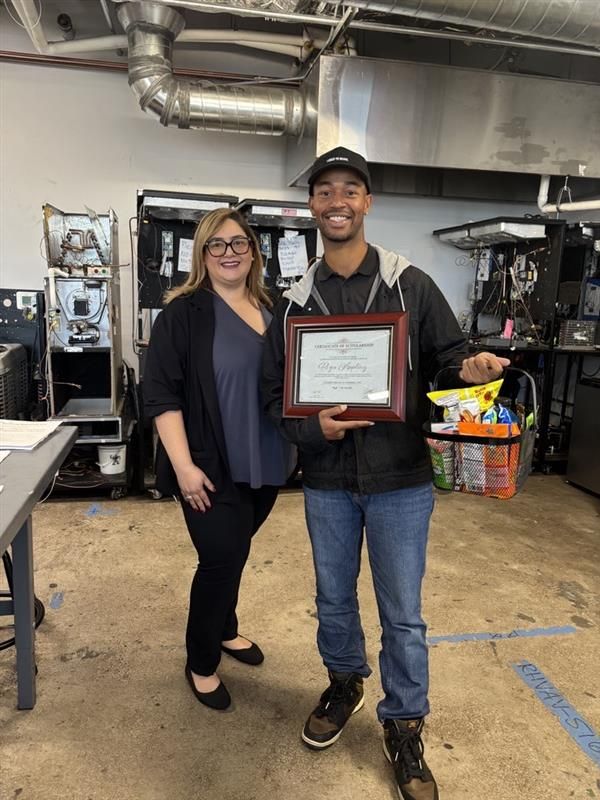
UEI College’s HVAC Training Program is built to prepare students for working in the real world. Our experienced instructors have worked in the field and bring a unique perspective to each class, mixing the curriculum with real-world application. Our programs are designed to provide hands-on opportunities to practice each skill.
What also sets UEI College apart is our support for our students. Instructors are committed to going above and beyond with tutoring and extra lab time to help students understand what they’re learning. Mentoring among students happens naturally throughout the program. From the moment you enroll through to when you’re hired, UEI College is there to support you on your journey.
Should You Enroll in an HVAC Training Program?
Is it worth the cost of a training program to become an HVAC technician? Yes!
Training through an HVAC training program is a good idea because:
- Employers prefer to see HVAC training on a resume. Some employers promise on-the-job training for HVAC technicians, but those positions may only be available during peak seasons. With thorough training, you can make yourself an asset to any HVAC company at any time of the year.
- HVAC school is quick and affordable. HVAC training can be completed in as few as 10 months at UEI College. This makes it easy to transition into the field. The quick program also makes it more affordable than a two- or four-year university degree that might be required for other professions.
- The training can be completed on a part-time basis during flexible hours. UEI College's hybrid schedule with daytime or evening classes makes it possible to begin training for a career while still maintaining current employment. It’s always a big commitment to go back to school, but we know our students have a lot going on in life, t With some commitment, you can juggle both!
- With the right training, you can quickly advance in the field. There are many specialties you could get into in the HVAC field, and UEI College introduces these opportunities, even if you decide not to go down that path. The more experience and specialized certifications you are able to obtain, the stronger your expertise will be.
How to Become an HVAC Technician?
It’s relatively simple to begin a career in HVAC. To become an HVAC technician, you should:
- Have a high school diploma or equivalent. A high school education is the minimum education requirement.
- Enroll in an HVAC training program. Some companies will offer on-the-job training, but learning by watching is not the same as the comprehensive, hands-on training offered through an HVAC program.
- Get certified. Certifications are a must-have on any HVAC resume.
- Apply for open positions in the HVAC field.
Enroll at UEI College to Become an HVAC Technician
If you’re ready to begin training for a new career in the HVAC field, you can get started quickly at UEI College. UEI College's HVAC Program can be completed in as few as 10 months, and with ongoing enrollment, you can enroll today and begin classes on the next start date.
Find a UEI College campus near you to take a tour or contact us to learn more information about UEI College's skilled trades programs.